Quick answer
Choose an off-the-shelf ERP such as SAP Business One, Odoo, Microsoft Dynamics 365 Business Central or NetSuite when your finance, inventory and sales processes are broadly standard. Choose custom ERP when a core process is your competitive advantage and packages would force costly workarounds. Many businesses do best with a hybrid: a packaged ERP for accounting and compliance, extended with custom modules and integrations.
Key takeaways
- Decide by process, not by product: standard back-office processes suit packaged ERP; differentiating operational processes may justify custom software.
- Total cost of ownership is driven by licences or subscriptions, implementation, customisation, integrations, upgrades, hosting, support and internal staff time.
- SAP Business One, Business Central, Odoo and NetSuite all support extensions, but each has its own toolset and limits that shape what customisation costs over time.
- A hybrid approach keeps accounting and tax on a maintained platform while custom modules handle unique workflows.
- Whatever you choose, plan data migration, integrations and regional compliance such as e-invoicing from day one.
Every growing business reaches the point where spreadsheets, a basic accounting package and a handful of disconnected apps stop coping. Stock figures disagree, month-end takes too long and nobody trusts the reports. That is when the ERP question arrives.
An enterprise resource planning (ERP) system is software that runs core operations, typically finance, inventory, purchasing, sales and often HR, on a single shared database. The choice is usually framed as "SAP, Odoo, Dynamics or NetSuite?", but the more useful first question is whether your processes are standard enough for any package, or distinctive enough to justify building.
This guide gives you a decision framework, compares the main options, explains what drives total cost of ownership and shows when a hybrid is the smarter answer.
What Is the Difference Between a Custom ERP and an Off-The-Shelf ERP?
An off-the-shelf ERP is a packaged product, licensed or subscribed to, that you configure to fit your business. A custom ERP is software designed and built around your own processes, which you own and maintain. The trade-off is speed and shared upkeep versus fit and control.
Packaged ERPs encode common practice. Their accounting, tax and inventory logic has been tested by many customers, and the vendor maintains it. In exchange, you adapt some of your processes to the software, and deeper changes go through the vendor's extension tools and, usually, an implementation partner.
A custom ERP starts from your workflows. It can model unusual pricing, production steps, approval chains or industry rules exactly. In exchange, you carry the cost and responsibility for everything, including the "boring" parts such as audit trails, period closing and tax reporting.
How Do SAP Business One, Odoo, Dynamics 365 and NetSuite Compare with Custom ERP?
All four packaged options target small and mid-sized organisations and can be extended, but they differ in deployment, extension tools and ecosystem. A custom ERP differs from all of them in ownership and flexibility.
| Option | Typical fit | How it is extended | Deployment | Main trade-off |
|---|---|---|---|---|
| SAP Business One | Small and midsize companies, often with inventory and distribution | Customisation and add-ons, usually through SAP partners | Delivered through partners; options vary by partner | Strong core; customisation and support depend heavily on partner quality |
| Odoo | Businesses wanting a modular suite that starts small and adds apps | Custom modules (Python and XML) on the open framework | Vendor cloud, platform hosting or self-hosted, by edition | Very flexible; heavy customisation can complicate version upgrades |
| Microsoft Dynamics 365 Business Central | Small and medium-sized businesses, especially Microsoft 365 users | AL extensions that add to base objects without modifying them | Cloud-first | Clean extension model; best value inside the Microsoft ecosystem |
| Oracle NetSuite | Growing, often multi-entity companies wanting cloud ERP | SuiteBuilder, SuiteScript (JavaScript), SuiteFlow workflows, SuiteTalk integrations | Cloud only | Customisations carry forward through releases; subscription commitment |
| Custom ERP | Businesses whose core operations differ materially from standard practice | Anything; you own the code | Your choice of cloud or on-premise, including in-country hosting | Perfect fit and ownership; you fund and maintain everything |
Vendor details come from the vendors' own materials. SAP positions Business One for small and midsize companies and directs buyers to its partner finder. Microsoft describes Business Central as business management software for small and medium-sized businesses and documents an extension model in which "you define functionality as an addition to existing objects". Oracle states that customisations built with SuiteCloud tools "automatically carry forward with every new product release".
Odoo is available as an open-source Community edition and a paid Enterprise edition, with hosting options that affect how much custom code you can deploy. Check the current edition and hosting rules with Odoo before you plan custom modules.
When Does a Custom ERP Make Sense?
Build custom when a core operational process is genuinely different from what packages model, when that process is a source of competitive advantage, or when integration and data-control needs make a package awkward. If none of these apply, a configured package is usually the better investment.
Strong signals that custom is worth evaluating:
- Your workflow is the product. Specialised production, project-based manufacturing, rental and asset tracking, or industry-specific compliance that packages handle only through heavy workarounds.
- Users fight the package. Staff keep side spreadsheets because the system cannot represent how work actually happens.
- Many systems must share one truth. Warehouses, marketplaces, field teams and partners need real-time data the package cannot expose cleanly.
- Per-user pricing scales badly. Large numbers of occasional users, such as warehouse or field staff, make subscription models expensive relative to the value each user gets.
- Data location or ownership is non-negotiable. A client, regulator or your own policy requires full control of hosting and code.
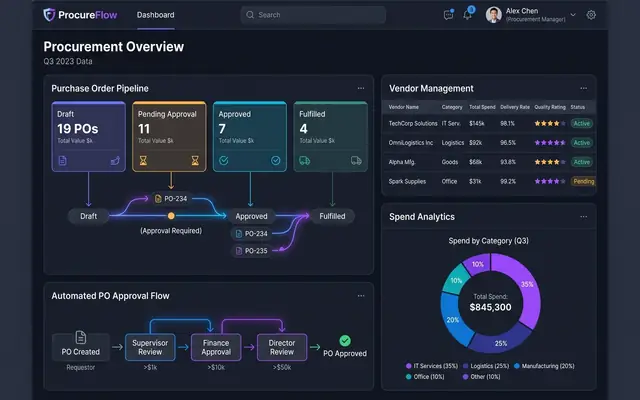
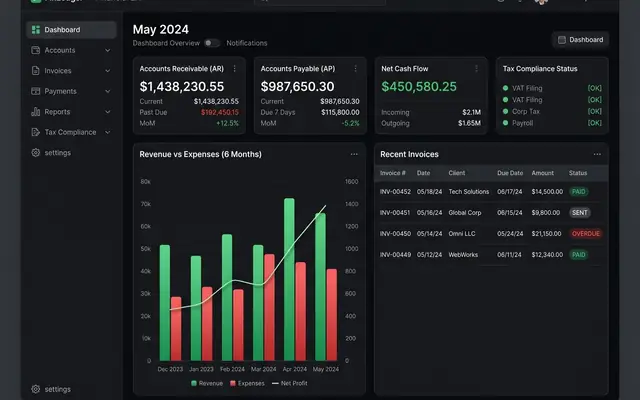
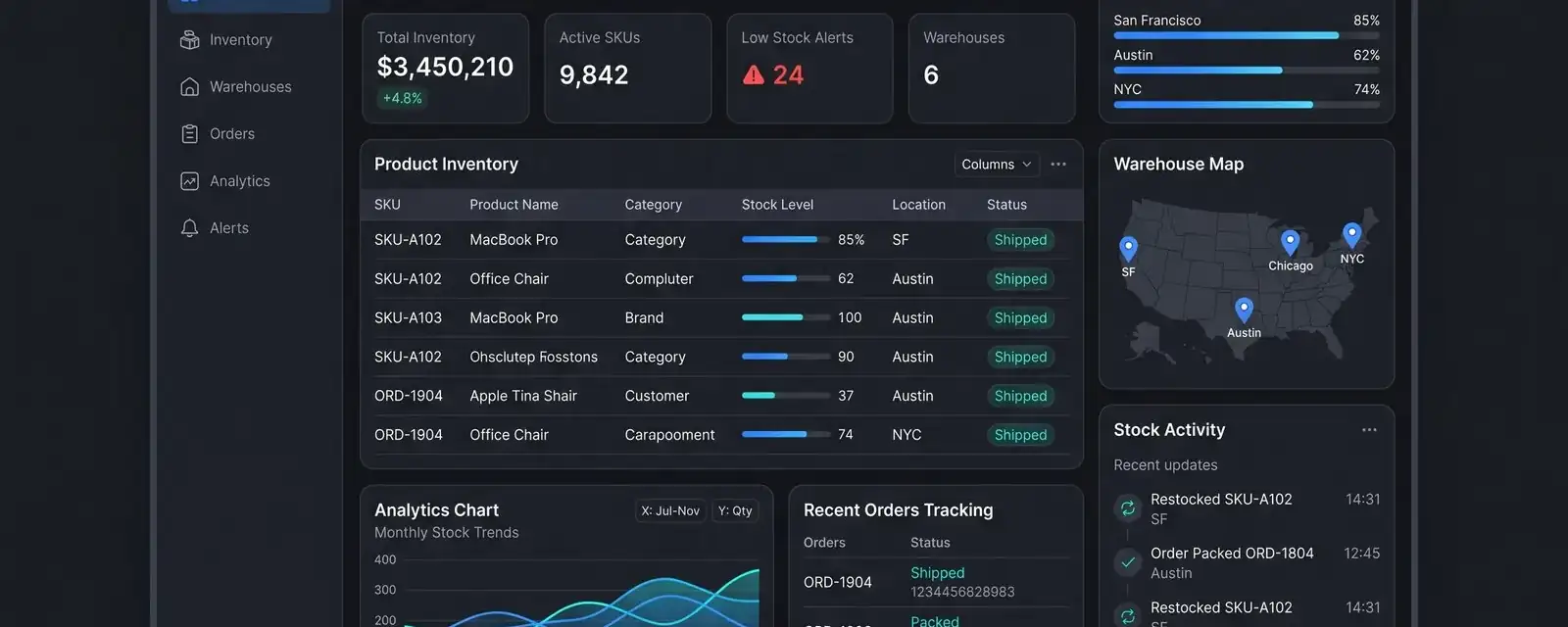
VEATEX has built custom ERP modules of this kind, including NexCore ERP for inventory across 12 warehouses, FinLedger for finance, WorkForce Pro for HR and payroll, and ProcureFlow for procurement. Each started from a specific operational need rather than a feature list.
When Is an Off-The-Shelf ERP the Better Choice?
Choose a packaged ERP when your processes follow common practice, you need to go live relatively quickly, and you would rather pay for maintained accounting, tax and reporting than build it. For most small and mid-sized businesses, finance and standard inventory fall into this category.
Packages are particularly strong where rules change often. When tax regimes, reporting formats or e-invoicing requirements change, vendors and their partners update the product for many customers at once. A custom system has to absorb those changes on its own budget.
A package is also easier to staff. Accountants, consultants and new hires may already know the system, and there is a partner market if your relationship with one implementer ends.
What Drives the Total Cost of Ownership of an ERP?
Total cost of ownership (TCO) is the full cost of acquiring, implementing and running a system over its life, not just the licence or build price. The same drivers apply to both routes, but they weigh differently.
- Licences or subscriptions: per user, per module or per entity for packages; none for custom, but hosting and third-party services still cost money.
- Implementation: process mapping, configuration, data migration, testing and training. This is often underestimated for packages and custom alike.
- Customisation and extensions: every change to a package adds build cost now and testing cost at each upgrade.
- Integrations: ecommerce, banks, payroll, logistics, e-invoicing and BI tools. Each connector needs building, monitoring and maintenance.
- Upgrades and regulatory change: vendor-led for packages; your responsibility for custom software.
- Hosting and security: included in SaaS subscriptions; a separate line for self-hosted or custom systems.
- Support and maintenance: partner or vendor support contracts versus a development team retainer.
- Internal time: the hours your own finance, operations and IT people spend on design, testing, training and data clean-up.
- Exit cost: how hard it is to move data and processes elsewhere later.
What Is a Hybrid ERP and When Should You Use One?
A hybrid ERP keeps a packaged system as the system of record for accounting, tax and master data, and adds custom-built modules or apps for the processes that differentiate you. It is often the lowest-risk way to get both compliance and fit.
Typical hybrid patterns include:
- a packaged ERP for the general ledger and VAT, with a custom warehouse or production app feeding it transactions;
- a custom customer or supplier portal that reads and writes to the ERP through its API;
- custom approval and procurement workflows that post approved purchase orders into the ERP;
- a reporting layer that combines ERP data with ecommerce, CRM and operational data.
The hybrid route depends on clean integrations. Use the vendor's supported APIs and extension model, keep business logic in one place, and document which system owns which data. Our guide to which business processes to automate first can help you decide where custom modules add the most value.
How Do You Decide? A Step-By-Step Framework
Decide by mapping processes first and products second. The aim is to identify which processes are standard, which are differentiating, and what each option would cost to support them over time.
- List your core processes end to end: order to cash, procure to pay, plan to produce, hire to pay and record to report.
- Mark each process as standard, adapted or differentiating.
- Shortlist two or three packages and ask partners to demonstrate your real scenarios with your data, not a generic demo.
- Estimate custom build scope only for differentiating processes, plus the integrations they need.
- Compare TCO over several years using the drivers above.
- Check regional compliance: VAT, corporate tax records, payroll rules and e-invoicing for every country you operate in.
- Plan delivery in phases, with a first go-live that proves value within a single area.
Regional requirements can tip the decision. In the UAE, e-invoicing requires invoice data in the PINT AE format to be exchanged through an Accredited Service Provider, and the Ministry of Finance's guidelines tell businesses to check that their accounting or ERP systems "can generate and extract all the data points that are required". Our guides to ERP for SMEs in the UAE and connecting your ERP to UAE e-invoicing cover this in depth.
What Should You Ask Before Hiring a Team to Build or Extend an ERP?
Ask who owns the code and data, how the system will be maintained after launch, and how the team handles accounting and compliance logic. These answers matter more than the technology stack.
- Will we own the source code, repositories, infrastructure accounts and documentation?
- How are accounting rules, audit trails and period locks designed and tested?
- Which parts will use the vendor's supported extension model, and what happens at each upgrade?
- How will data be migrated, reconciled and signed off?
- What does support look like in the first year, and who can take over if needed?
If the team is offshore or nearshore, our guide to outsourcing software development safely covers contracts, IP and communication.
How VEATEX Helps
VEATEX is a Shopify, web and software development agency that also builds Peppol e-invoicing platforms for the GCC, working with clients in the US, UK and the Gulf for over 11 years. We build custom ERP modules, such as NexCore ERP, FinLedger, WorkForce Pro and ProcureFlow, and integrate custom software with packaged ERPs where a hybrid fits better. Start with a process review on our custom software and ERP development page, or tell us what you need.
Frequently Asked Questions
Is a custom ERP cheaper than SAP Business One or Odoo?
Sometimes over the long term, rarely at the start. A custom ERP avoids per-user subscriptions but carries the full cost of design, build, testing, hosting and ongoing maintenance, and you own every future change. A packaged ERP spreads development cost across many customers but adds licences, partner fees and customisation work. Compare total cost of ownership over several years for your specific scope rather than headline prices.
How long does it take to build a custom ERP?
It depends on the number of modules, integrations and users, and on how quickly decisions are made. Most custom ERPs are delivered in phases: a first module such as inventory or procurement goes live, then finance links, reporting and further modules follow. Phased delivery reduces risk compared with a single large launch and lets users shape later modules based on real use.
Can we customise Odoo or Business Central instead of building custom?
Yes, and that is often the best route. Business Central is extended through AL extensions that add tables, pages and logic without changing the base application. Odoo is built from modules and can be extended with custom modules, depending on edition and hosting. NetSuite uses SuiteScript and SuiteFlow. Keep customisations within each vendor's supported extension model so upgrades remain manageable.
What is a hybrid ERP approach?
A hybrid ERP keeps a packaged system as the system of record for finance, tax and core master data, and adds custom software for processes the package handles poorly, such as a specialised production workflow, a field service app or a customer portal. The parts are connected through APIs, so each does what it is best at and the business avoids heavily modifying the core ERP.
What are the biggest risks of a custom ERP?
The main risks are unclear requirements, dependence on a small team that holds all the knowledge, weak documentation, and underestimating accounting and compliance logic such as tax, multi-currency and audit trails. Mitigate them with phased delivery, ownership of source code and infrastructure, automated tests, documented data models and a maintenance agreement agreed before go-live.
Does the choice between custom and packaged ERP affect UAE e-invoicing?
Yes. UAE e-invoicing requires invoice data in the PINT AE format to be sent through an Accredited Service Provider. Packaged ERPs may offer connectors through partners, while a custom ERP needs its invoice data model and an ASP integration built in. Either way, check that the system can capture every required field and handle credit notes, corrections and status messages.
Sources
- SAP Business One — SAP
- Dynamics 365 Business Central — Microsoft
- Developing extensions in AL — Business Central developer overview, Microsoft Learn
- SuiteCloud Platform data sheet — Oracle NetSuite
- UAE Electronic Invoicing Guidelines v1.0 (February 2026) — UAE Ministry of Finance
Facts checked against the sources above as of 6 Oct 2026. Rules and platform features change, so confirm time-sensitive details before acting.

VEATEX Editorial Team
Written by the strategists, developers and e-invoicing engineers at VEATEX, a Shopify, web and software development agency that also builds Peppol e-invoicing platforms for the GCC, with 1,200+ projects delivered over 11+ years. About us