Quick answer
A UAE SME's ERP should produce VAT-ready records and returns, generate every PINT AE data field and connect to an Accredited Service Provider for e-invoicing, keep corporate tax records that reconcile to financial statements, and handle multiple branches, currencies and Arabic documents. Businesses with revenue below AED 50 million must appoint an ASP by 31 March 2027 and go live by 1 July 2027.
Key takeaways
- UAE e-invoicing covers B2B and B2G transactions on a Peppol-based five-corner model, using the PINT AE data standard and an Accredited Service Provider (ASP).
- Businesses with revenue of AED 50 million or more must appoint an ASP by 30 October 2026 and go live on 1 January 2027; smaller businesses follow by 31 March and 1 July 2027.
- Corporate tax is 0% on taxable income up to AED 375,000 and 9% above it, so the ERP must support clean, auditable financial statements.
- E-invoices must be issued within 14 days of the transaction, and e-invoice data must be stored in the UAE.
- Multi-branch, multi-currency and bilingual Arabic–English output should be tested before you choose or build an ERP.
For a small or medium-sized enterprise (SME) in the UAE, the case for a proper ERP used to be about efficiency: one system for stock, sales, purchasing and accounts instead of spreadsheets. Since VAT, corporate tax and now e-invoicing, it has also become a compliance question.
The UAE's e-invoicing programme means invoice data must flow from your system, in a defined structure, through an approved provider to your customer and the tax authority. Corporate tax means your books must stand up to scrutiny. And many SMEs run several branches, trade in more than one currency and need Arabic documents.
This guide sets out what a UAE SME's ERP needs to do as of October 2026, how to test a system against those needs, and when building custom modules makes sense.
What Does a UAE SME Need from an ERP in 2026?
A UAE SME needs an ERP, or an accounting system working with one, that keeps VAT-ready records, produces PINT AE e-invoice data and connects to an Accredited Service Provider, supports corporate tax reporting, and handles multiple branches, currencies and languages. Inventory, purchasing and payroll needs come on top.
| Requirement | Why it matters in the UAE | What to test in a demo |
|---|---|---|
| VAT records and returns | VAT at 5% applies to most supplies; returns must reconcile to ledgers | Tax codes per item and customer, reverse charge, a draft VAT return from real data |
| E-invoice data (PINT AE) | B2B and B2G invoices must be issued electronically in the PINT AE format | All mandatory fields captured; credit notes linked to original invoices |
| ASP connection | Invoices are exchanged and reported through an Accredited Service Provider | A live or sandbox send, rejection handling and status updates in the ERP |
| Corporate tax support | 9% above AED 375,000 of taxable income; returns due within 9 months of period end | Financial statements, adjustments and an audit trail |
| Multi-branch and multi-entity | Branches across emirates, free zone and mainland entities, tax groups | Branch-level reporting, inter-company transactions, consolidation |
| Multi-currency | Trade in USD, EUR, SAR and other currencies with AED reporting | Exchange rate handling and AED tax amounts on foreign currency invoices |
| Arabic output | Customers and authorities may expect Arabic or bilingual documents | Bilingual invoice templates rendering Arabic correctly |
| UAE data storage | E-invoice data must be stored within the UAE | Where the ERP and its backups are hosted |
How Does UAE E-Invoicing Affect Your ERP?
UAE e-invoicing requires B2B and B2G invoices to be issued as structured data in the PINT AE format and exchanged through Accredited Service Providers on a Peppol-based five-corner model. Your ERP becomes the source of that data, so its quality decides whether invoices pass validation.
The Ministry of Finance (MoF) describes the model as Decentralised Continuous Transaction Control and Exchange (DCTCE). The supplier's ERP sends invoice data to its ASP, which delivers it to the buyer's ASP and reports it to the Federal Tax Authority (FTA). The full flow is explained in our guide to the five-corner model.
PINT AE is the UAE specialisation of Peppol International (PINT), built on the UBL 2.1 syntax. It defines which data elements a UAE invoice must contain and the business rules they must satisfy. Our PINT AE explainer walks through the fields.
Key obligations under Ministerial Decision No. 243 of 2025 that affect ERP design:
- Issue within 14 days: an e-invoice or e-credit note must be issued and transmitted within 14 days of the date of the transaction.
- Report system failures: issuers and recipients must notify the FTA of a system failure within 2 business days.
- Keep ASP data current: changes to registered data must be passed to your ASP within five business days of FTA confirmation.
- Store data in the UAE: e-invoices, e-credit notes and associated data must be stored within the State.
Your participant identifier is your Tax Identification Number (TIN), which the MoF guidelines define as the first 10 digits of your 15-digit Tax Registration Number (TRN). Some transactions are excluded, including certain international airline passenger services and certain VAT-exempt financial services; check the decision for the full list.
What Are the UAE E-Invoicing Deadlines for SMEs?
Businesses with revenue below AED 50 million must appoint an ASP by 31 March 2027 and go live by 1 July 2027. Larger businesses must appoint by 30 October 2026 and go live on 1 January 2027. Voluntary adoption opened on 1 July 2026.
- 1 July 2026: pilot and voluntary adoption begin.
- 30 October 2026: businesses with revenue of AED 50 million or more must appoint an ASP (extended from 31 July 2026 by Ministerial Resolution No. 66 of 2026).
- 1 January 2027: mandatory go-live for businesses at or above AED 50 million.
- 31 March 2027: businesses below AED 50 million, and government entities, must appoint an ASP.
- 1 July 2027: mandatory go-live for businesses below AED 50 million.
- 1 October 2027: go-live for government entities.
The MoF's June 2026 programme update listed 41 pre-approved providers, with more under review, and confirmed that ASPs are selected through the EmaraTax platform. See our detailed UAE e-invoicing deadlines guide and the consequences of missing them in UAE e-invoicing penalties explained.
What Should Your ERP Do for VAT Returns?
For VAT, the ERP should apply the correct tax treatment to every line automatically and produce a return that reconciles to the general ledger without manual adjustments. Most VAT problems start with master data, not with the return.
Check that the system can:
- assign tax codes by item, service and customer, including standard-rated, zero-rated, exempt and out-of-scope supplies;
- handle reverse charge on imported services and goods;
- record the customer's TRN and validate its format before invoicing;
- show VAT amounts in AED on invoices issued in foreign currencies;
- produce return figures by emirate where your VAT return requires it;
- keep tax invoices, credit notes and adjustments linked and retrievable for audit.
Once e-invoicing goes live, the same data feeds both the VAT return and the e-invoice. That is a strong reason to fix tax master data once, in the ERP, rather than in spreadsheets downstream.
What Corporate Tax Record-Keeping Does the ERP Need to Support?
UAE corporate tax applies at 0% on taxable income up to AED 375,000 and 9% above that, for financial years beginning on or after 1 June 2023. The ERP must support accurate financial statements and the adjustments that turn accounting profit into taxable income.
Even small businesses must register and file. Small Business Relief, set out in Ministerial Decision No. 73 of 2023, lets resident persons with revenue not exceeding AED 3 million be treated as having no taxable income for tax periods ending on or before 31 December 2026, but they still file returns and cannot carry forward losses from relief periods. Returns are due within nine months of the end of the tax period.
In ERP terms, that means:
- a chart of accounts that separates non-deductible and partially deductible expenses, such as certain entertainment costs;
- related-party and inter-company transactions flagged and reportable;
- fixed asset registers with depreciation schedules;
- period locks and a full audit trail of postings and changes;
- exportable financial statements for your accountant or auditor.
Confirm current rules, thresholds and record retention periods with the FTA or a registered tax agent, as these can change.
How Should an ERP Handle Multi-Branch, Multi-Currency and Arabic?
Configure branches, entities and currencies at the start, not after go-live. Retrofitting a single-company ERP into a multi-branch, multi-currency structure is one of the most disruptive changes an SME can make.
Multi-branch: track sales, stock and costs by branch or warehouse while reporting VAT under the correct registration. Mainland and free zone entities may have different licensing and tax positions, so model them as separate entities where they are separate legal persons.
Multi-currency: record foreign currency transactions with the exchange rate used, revalue balances at period end, and always show tax in AED where required.
Arabic: at minimum, invoices and customer-facing documents should render Arabic text correctly in right-to-left direction, with bilingual templates where customers expect them. Check names, addresses and item descriptions in both scripts.
Payroll: if HR and payroll sit in the ERP, it should produce salary files for the UAE Wage Protection System (WPS) used by employers registered with the Ministry of Human Resources and Emiratisation (MoHRE).
Should a UAE SME Choose a Packaged ERP or Build One?
Most UAE SMEs should start with a packaged ERP or accounting system that already has a tested e-invoicing connector, and add custom modules only where operations demand it. Tax logic changes, and vendors maintain it for many customers at once.
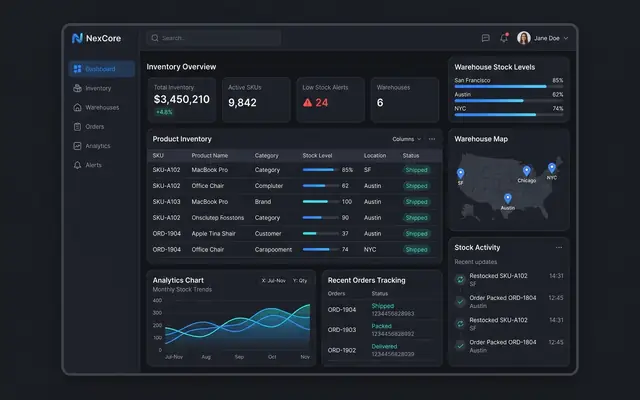
Custom development makes sense for workflows that packages handle badly: complex multi-warehouse inventory, project and contract billing, rental, or industry-specific operations. VEATEX has built modules of this kind, such as NexCore ERP for inventory across 12 warehouses, FinLedger for finance, WorkForce Pro for HR and payroll, and ProcureFlow for procurement.
Whichever route you take, the e-invoicing integration needs to be planned. Our guide to custom ERP versus SAP, Odoo, Dynamics or NetSuite covers the decision, and connecting your ERP to UAE e-invoicing covers the integration for common systems.
How VEATEX Helps
VEATEX is a Shopify, web and software development agency that also builds Peppol e-invoicing platforms for the GCC, working with clients in the US, UK and the Gulf for over 11 years. We built a Peppol platform for a client that passed OpenPeppol testing and is now on the UAE pre-approved ASP list. For SMEs, we build custom ERP modules and connect ERPs to e-invoicing. See our custom software and ERP development and e-invoicing services.
Frequently Asked Questions
Do UAE SMEs need an ERP for e-invoicing?
Not necessarily a full ERP, but you need a system that can produce structured invoice data with every field PINT AE requires and pass it to your Accredited Service Provider. Some SMEs use accounting software with an ASP connector; others use an ERP. The real test is whether your system holds clean customer TRNs, item tax treatments, credit note links and status updates, and whether staff can fix rejections quickly.
When must a UAE SME start e-invoicing?
Under Ministerial Decision No. 244 of 2025, businesses with annual revenue below AED 50 million must appoint an Accredited Service Provider by 31 March 2027 and implement e-invoicing by 1 July 2027. Businesses at or above AED 50 million must appoint an ASP by 30 October 2026, following a 2026 amendment, and go live on 1 January 2027. Voluntary adoption has been possible since 1 July 2026.
What is an Accredited Service Provider (ASP)?
An Accredited Service Provider is a company approved by the UAE Ministry of Finance to exchange e-invoices on the Peppol network and report invoice data to the Federal Tax Authority. Your ERP or accounting system sends invoice data to your ASP, which validates it, delivers it to the buyer's ASP and reports it. You select your ASP through the EmaraTax platform, as of October 2026.
Does a small business with low profits still need corporate tax records?
Yes. Even when taxable income falls within the 0% band up to AED 375,000, or the business elects Small Business Relief, it still has to register and file corporate tax returns. That requires reliable financial statements and supporting records, so the ERP or accounting system must keep complete ledgers, invoices and adjustments, not just VAT data.
Can an ERP handle multiple branches and emirates under one TRN?
Yes, if it is configured for it. Many UAE groups operate several branches, warehouses or emirates under one VAT registration, or several legal entities in a tax group. The ERP should track transactions by branch and entity, produce consolidated VAT returns where appropriate, and keep e-invoice participant identifiers and addresses correct for each legal entity.
Should a UAE SME build a custom ERP or buy one?
Most SMEs should start from a packaged ERP or accounting system with a proven UAE e-invoicing connector, because tax and compliance logic changes and vendors maintain it. Custom modules make sense for operations that packages handle poorly, such as specialised inventory or service workflows. A hybrid, with packaged finance and custom operational modules, is common in the region.
Sources
- UAE eInvoicing Programme update (30 June 2026) — UAE Ministry of Finance
- Ministerial Decision No. 243 of 2025 on the Electronic Invoicing System — UAE Ministry of Finance
- Ministerial Decision No. 244 of 2025 on the Implementation of the Electronic Invoicing System — UAE Ministry of Finance
- Ministerial Resolution No. 66 of 2026 amending Ministerial Resolution No. 244 of 2025 — UAE Ministry of Finance
- UAE Electronic Invoicing Guidelines v1.0 (February 2026) — UAE Ministry of Finance
- PINT AE billing specification — Peppol (OpenPeppol)
- Corporate tax — The Official Portal of the UAE Government (u.ae)
- New Ministerial Decision offers relief to small businesses and start-ups — Deloitte Middle East
- Corporate Tax — UAE Ministry of Finance
Facts checked against the sources above as of 6 Oct 2026. Rules and platform features change, so confirm time-sensitive details before acting.

VEATEX Editorial Team
Written by the strategists, developers and e-invoicing engineers at VEATEX, a Shopify, web and software development agency that also builds Peppol e-invoicing platforms for the GCC, with 1,200+ projects delivered over 11+ years. About us