
Quick answer
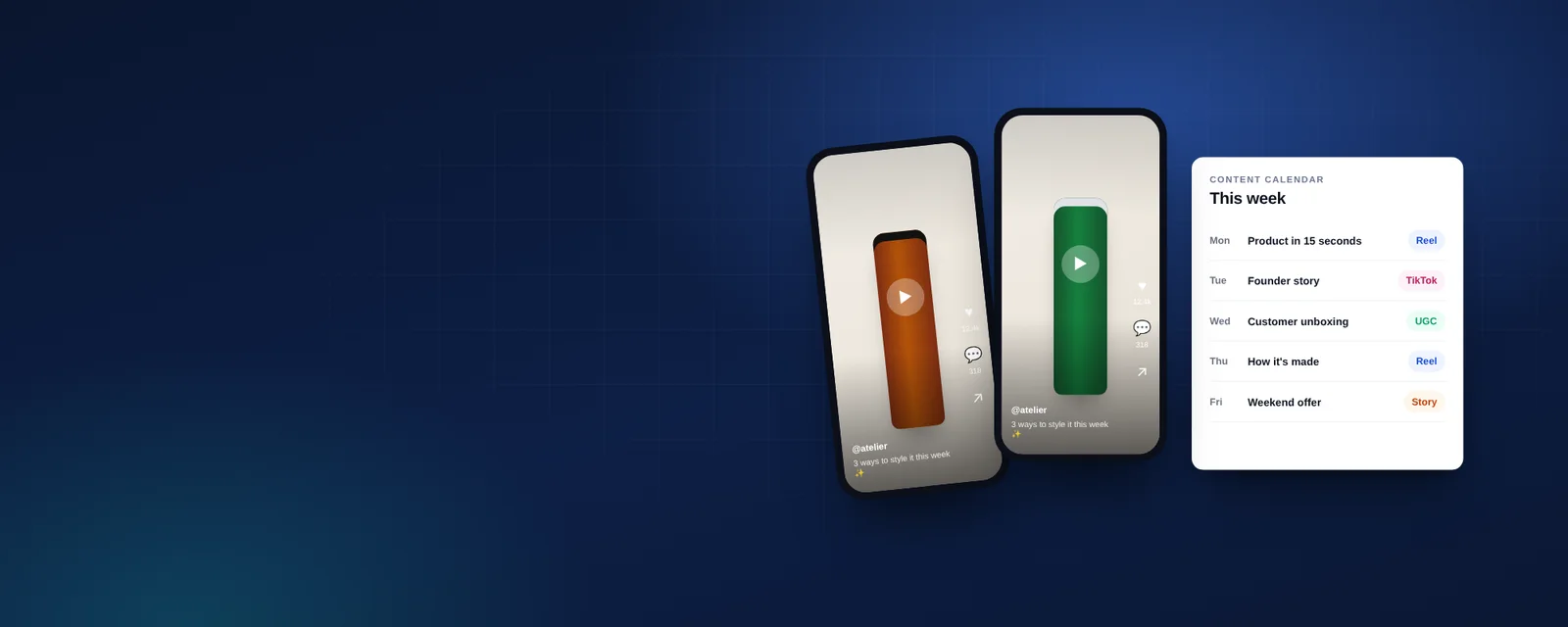
A strong Reels and TikTok strategy for a product brand combines a few repeatable formats, such as demos, problem-solution, before-and-after, unboxings and founder stories, with hooks that land in the first second, native editing, captions and a consistent posting rhythm. Test several hooks per idea, learn from watch time, shares and saves, and turn proven organic videos into ads.
Key takeaways
- Build around five or six repeatable formats instead of starting from zero every week.
- The first second decides reach; lead with the result, the problem or a surprising visual.
- Native, human editing usually beats polished commercials on short-form platforms.
- Use trends selectively, and keep most content evergreen and product-led.
- Judge videos on hook rate, watch time, shares, saves and clicks, then promote the winners.
For product brands, Reels and TikTok are now the shop window, the word of mouth and the ad testing lab all in one. A single strong video can introduce your product to more people in a week than a year of static posts.
But most brand videos disappear without a trace. The difference is rarely budget. It's strategy: knowing which formats to repeat, how to hook viewers in the first second and how to learn from every post. This guide sets out a practical approach you can start this week.
How Do Reels and TikTok Decide Who Sees Your Video?
Both platforms recommend videos based on how people respond to them, not only on how many followers you have. Instagram has explained that its ranking considers signals such as how likely people are to watch, like, share or comment on content. In practice, that means a new brand with a strong video can reach far beyond its followers, and a weak video from a big account can flop.
The signals to optimise for are simple: people stopping to watch, watching to the end, rewatching, sharing, saving and commenting.
Which Video Formats Work Best for Product Brands?
Build your strategy around a handful of repeatable formats. Each one can be reused with different products, customers and angles for months.
| Format | What it shows | Best for |
|---|---|---|
| Product demo | The product doing its job, close up | Consideration and conversion |
| Problem and solution | A frustration, then your fix | Reach and relevance |
| Before and after | A visible transformation | Hooks and shares |
| Unboxing and first impressions | Packaging and honest reactions | Trust and UGC |
| Founder and making-of | Who's behind the brand and how it's made | Loyalty and story |
| Tips and how-to | Useful advice related to your category | Saves and follows |
How Do You Write Hooks That Stop the Scroll?
The first second decides whether anyone sees the rest. Lead with the most interesting part of the video, not a logo or an introduction.
- Show the result first: the finished look, the clean surface, the perfect pour.
- Name the problem: "If your coffee tastes bitter, it's probably this."
- Use a pattern break: an unexpected visual, movement or sound.
- Ask the customer's question: "Is this actually worth it?"
- Add on-screen text so the hook works with the sound off.
Tip: film three or four different openings for every video idea and keep the rest the same. Hooks are the fastest lever you have, and testing them costs almost nothing.
Polished or Native: Which Style Works Better?
On short-form platforms, native usually wins. Videos that look like they belong in the feed, filmed vertically on a phone, with natural speech, quick cuts and captions, tend to hold attention better than repurposed TV-style commercials. TikTok's own creative guidance for advertisers emphasises content that feels native to the platform. Polished production still has a place for hero launches and product photography, but your weekly content engine should feel human.
How Should You Balance Trends and Evergreen Content?
Use trends as seasoning, not the meal. A sensible split for most product brands is around 80% evergreen, product-led formats and 20% trends, reactive posts and experiments. Join a trend only when it fits your product and voice naturally and you can make it quickly while it's still relevant. Evergreen formats keep working for months and can be turned into ads.
What Posting Rhythm Should Product Brands Follow?
Pick a rhythm you can sustain with good quality. Three to five short videos a week on your main platform is a realistic starting point for many brands, plus stories for day-to-day presence. Batch-film once or twice a week, schedule ahead and keep a few flexible slots for reactive content. Review results monthly and change the mix of formats based on what performed.
How Do Creators Fit into Your Short-Form Strategy?
Creators add reach, credibility and fresh ideas. Gift products to creators whose audiences match yours, give a short brief with key points and claims to avoid, and let them use their own style. Make sure partnerships are disclosed clearly, as the FTC expects in the US. If you plan to run their videos as ads, agree usage rights and pay for them. Our guide to organic growth for new ecommerce brands covers creator programmes on a small budget.
Can AI Help Produce Reels and TikToks?
Yes, especially for scripting, editing, captions, translations and b-roll. Keep real products and people at the core, review everything for accuracy and disclose realistic AI-generated content where platforms require it. YouTube, for example, requires disclosure when AI is used to meaningfully alter or generate realistic content. See AI video for organic social for a full workflow.
How Do You Measure Short-Form Video Performance?
Look past views. These metrics tell you whether a video worked and why.
- Hook rate: the share of viewers who stay past the first few seconds.
- Average watch time and completion rate: whether the story holds.
- Shares and saves: whether people found it worth passing on or keeping.
- Comments: questions often reveal objections to address in the next video.
- Profile visits, link clicks and sales: whether attention turns into business.
When Should You Turn Organic Videos into Ads?
When a video beats your average on hook rate, watch time and engagement, test it as an ad. Organic performance is a cheap filter for creative, and proven videos usually give paid campaigns a head start. Create a few variations of the opening seconds and test them against each other. Our guide to Meta ads for Shopify stores explains how to structure those tests.
A Weekly Production System for Short-Form Video
Consistency comes from a system, not inspiration. A simple weekly rhythm keeps a small team publishing without stress.
- Plan (30 minutes): review last week's results and choose five ideas using your proven formats.
- Script (1 hour): write three hooks per idea and a short beat sheet.
- Film (2 to 3 hours): batch all videos in one session, including alternate hooks.
- Edit (half a day): cut, caption and export versions for each platform.
- Publish and engage: schedule posts and reply to comments in the first hour after posting.
Ten Hook Templates You Can Adapt
- "Stop doing this if you want [result]."
- "I tested [product] for 30 days. Here's what happened."
- "The [category] mistake almost everyone makes."
- "POV: you finally found a [product] that [benefit]."
- "Is [product] worth it? Honest review."
- "Three ways to use [product] you didn't know about."
- "What [price or effort] gets you vs what [alternative] gets you."
- "How we make [product], start to finish."
- "Reading our worst review."
- "Before vs after [using product]."
Only use claims you can support, and keep results realistic.
Captions, Sounds and On-Screen Text
Many people watch with the sound off, so add captions and short on-screen text that carries the key message. Use trending or licensed sounds where appropriate for the platform, but make sure commercial accounts only use audio they have the right to use. Keep important text away from the edges, where platform buttons and captions can cover it.
Regional Considerations for the US, UK and Gulf
Humour, pace and presenter style vary by market. US audiences often respond to energetic, direct presenters; UK audiences to dry humour and honesty; GCC audiences to polished visuals, bilingual captions and culturally aware styling. If you sell in several markets, test separate versions rather than assuming one video fits everyone.
Common Short-Form Video Mistakes Brands Make
- Opening with a logo or slow introduction instead of the most interesting moment.
- Repurposing TV ads without editing them for vertical, fast and sound-off viewing.
- Posting the same video everywhere with another platform's watermark still on it.
- Trying a new format every time, so nothing is repeated long enough to learn from.
- Ignoring comments, which are both a ranking signal and a source of new video ideas.
- Measuring only views rather than watch time, shares, saves and clicks.
- Making unsupported claims that create customer complaints or advertising issues.
Fixing just the first two usually makes the biggest difference for brands moving from traditional ads to short-form content.
How VEATEX Helps
VEATEX is a Shopify, web and software development agency that also builds Peppol e-invoicing platforms for the GCC, working with clients in the US, UK and the Gulf for over 11 years. We plan, film, edit and publish Reels and TikToks for product brands, combine real footage with AI-assisted production, and turn winning videos into ads. See our social media and content services or get a free content audit.
Frequently Asked Questions
Should brands post the same video on Reels and TikTok?
You can reuse the core idea, but adapt it. Use platform-native text, sounds and captions, remove other platforms' watermarks, and adjust length and pacing. Small edits often make a big difference to performance on each platform.
How long should Reels and TikToks be for product brands?
Long enough to deliver one clear idea and no longer. Many product demos work in 15 to 30 seconds, while tutorials and stories can run longer if they hold attention. Watch your completion and retention data to find the right length for your audience.
How often should a product brand post short-form video?
Consistency beats bursts. Many brands start with three to five videos a week on their main platform and increase volume only when quality and results hold. A steady rhythm also gives you enough data to learn from.
Are trends worth following for brands?
Sometimes. Trends can boost reach when they fit your product and voice naturally, but they date quickly. Most of your content should be evergreen formats that show the product and solve problems, with trends as an occasional extra.
What makes a good hook for a product video?
Show the result, the problem or something unexpected immediately. Strong hooks include a dramatic before-and-after, a bold claim you can back up, a common mistake, or a question your customer is already asking. Add on-screen text so the hook works without sound.
When should a brand turn organic videos into ads?
When a video performs well organically on hook rate, watch time and engagement, it's a strong candidate for paid testing. Get usage rights from any creators involved first, and test a few variations of the opening seconds.
Sources
- Instagram ranking explained — Instagram
- Creative that drives conversions — TikTok for Business
- Disclosures 101 for Social Media Influencers — FTC
- Disclosing use of GenAI content — YouTube Help
Facts checked against the sources above as of 7 Oct 2026. Rules and platform features change, so confirm time-sensitive details before acting.
VEATEX Editorial Team
Written by the strategists, developers and e-invoicing engineers at VEATEX, a Shopify, web and software development agency that also builds Peppol e-invoicing platforms for the GCC, with 1,200+ projects delivered over 11+ years. About us