Quick answer
AI video lets brands produce more Reels, Shorts and TikToks by speeding up scripting, editing, captions, voiceover, b-roll and visual variations. It works best combined with real product footage and real people, under a clear brand style and human quality checks. Platforms such as YouTube and Meta require or apply labels for realistic AI-generated content, so build disclosure into the workflow.
Key takeaways
- Use AI to speed up the parts of production that don't need a camera: scripts, edits, captions, voice and variations.
- Keep real products and real people at the centre; fully synthetic content can erode trust.
- A fixed brand style guide and human review keep AI content consistent and accurate.
- YouTube requires disclosure of realistic content made or meaningfully altered with AI, and Meta labels some AI content.
- Measure AI video like any other content: hook rate, watch time, shares, saves and clicks.
Short-form video is the main way new audiences discover brands, but it is also the most demanding format to produce. Every week needs new hooks, edits, captions and versions for each platform. AI tools have changed what a small team can produce, as long as they're used carefully.
This guide focuses on AI video for organic social content: the Reels, Shorts and TikToks you publish to grow an audience. If you're making paid ads, read our separate guide to AI product videos for ecommerce ads.
What Can AI Actually Do for Social Video?
AI is most useful for the slow, repetitive parts of production that don't need a camera. It speeds up preparation and post-production rather than replacing the idea or the product.
| Stage | How AI helps | Where humans still lead |
|---|---|---|
| Ideas and scripts | Generates hook options, outlines and script drafts | Choosing ideas that fit the brand and audience |
| Visuals | Creates b-roll, backgrounds, product scenes and transitions | Accurate product representation |
| Voice and language | Voiceovers, dubbing and translation, including Arabic | Tone, pronunciation and cultural nuance |
| Editing | Auto-cuts, captions, reframing and resizing | Pacing, taste and storytelling |
| Variations | Alternative hooks, endings and formats for testing | Deciding what to publish |
What Does an AI-assisted Video Workflow Look Like?
The most reliable workflows treat AI as a production assistant within a normal content process. A typical weekly cycle looks like this.
- Plan: pick the week's themes from your content pillars and last week's results.
- Script: use AI to draft several hooks and scripts, then a human edits for voice and accuracy.
- Capture: film real product shots, hands-on demos and people on a phone or in a studio.
- Enhance: add AI-generated b-roll, backgrounds or scenes where real footage isn't practical.
- Edit: use AI-assisted editing for rough cuts, captions and resizing for each platform.
- Review: a human checks brand fit, claims, product accuracy and disclosure needs.
- Publish and learn: post, then feed results back into next week's plan.
Which Tool Categories Do Brands Use?
Tools change quickly, so think in categories rather than specific products. Most teams combine a few of these.
- Text-to-video and image-to-video generators for scenes, b-roll and stylised visuals.
- AI avatars and voice for presenter-style explainers, used carefully and disclosed where required.
- AI editing assistants that cut clips, add captions and reframe for vertical formats.
- Dubbing and translation tools for reaching new markets in other languages.
- Design tools with generative features for thumbnails, covers and text overlays.
Tip: check each tool's commercial-use terms before you publish, and keep a simple log of which tools and source assets were used for every video. It makes disclosure and rights questions easy to answer later.
What Are the Disclosure and Labelling Rules?
Platforms want viewers to know when realistic content has been created or significantly changed with AI. Rules differ, so check each platform's current policy.
- YouTube requires creators to disclose when they use AI to meaningfully alter or generate realistic content, such as making a real person appear to say something they didn't or generating a realistic scene that didn't happen. Minor edits such as colour correction or beauty filters don't need disclosure.
- Meta has explained that it labels certain AI-generated or AI-edited content in its ads products.
- TikTok sets out expectations for creative integrity when using generative AI in advertising, and has rules for labelling AI-generated content.
- UK advertising rules: the ASA has published guidance on when AI use in advertising should be disclosed so that ads aren't misleading.
The simplest policy is to disclose whenever a viewer might reasonably believe something real happened when it didn't.
How Do You Keep AI Video on Brand?
Consistency comes from rules, not tools. Create a short AI style guide for your brand and use it for every video.
- Visual rules: colours, lighting, settings and styles that are allowed and not allowed.
- Product rules: products must be shown accurately, with no invented features, colours or results.
- People rules: when AI people may appear, and that real customers are never imitated.
- Voice rules: approved voices, pace and tone, including for Arabic and other languages.
- Review checklist: claims, spelling, captions, disclosure and music rights.
How Should You Mix AI and Real Footage?
Let real footage carry trust and let AI carry scale. Real hands using the product, real customers and real team members build credibility that synthetic content can't. AI is ideal for the surrounding pieces: establishing shots, backgrounds, product-in-context scenes, animated explainers, captions and localised versions. In the strongest brand videos, the AI-assisted parts are barely noticeable. Our guide to Reels and TikTok strategy for product brands covers the formats that work best.
How Do You Measure Whether AI Video Is Working?
Measure AI-assisted videos exactly as you would any other content. Platforms such as Instagram explain that ranking depends on how people interact with content, so focus on audience response.
- Hook rate: how many viewers stay past the first few seconds.
- Average watch time and completion: whether the story holds attention.
- Shares and saves: signals that the content is genuinely useful or entertaining.
- Comments: including whether people question authenticity.
- Profile visits and clicks: whether content leads anywhere for the business.
Compare AI-assisted videos against fully real ones over a month before deciding how much to scale.
Common Mistakes with AI Video
- Publishing everything the tool makes instead of curating the best.
- Uncanny people and voices that distract from the message.
- Inaccurate products that create disappointed customers and returns.
- Ignoring disclosure rules until a platform labels or removes content.
- Chasing volume over ideas: more videos with weak hooks won't grow an audience.
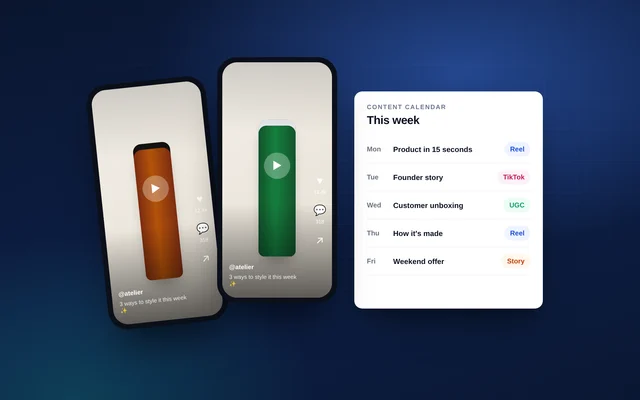
A Sample Weekly AI-assisted Content Plan
Here's how a small team might combine real filming with AI-assisted production to publish consistently without burning out.
| Day | Task | AI's role |
|---|---|---|
| Monday | Plan the week's ideas from last week's results | Suggests hook and angle variations |
| Tuesday | Film product demos and people on a phone | None, real footage |
| Wednesday | Rough cuts, captions and b-roll | Auto-cuts, captions, generated b-roll |
| Thursday | Versions for each platform and language | Reframing, translation and dubbing |
| Friday | Review, schedule and publish | None, human review and approval |
Using AI for Arabic and Multilingual Video
AI translation and dubbing make it practical to publish the same video in English and Arabic, or for several European markets. Use them as a first draft: a native speaker should review scripts, captions and voice for accuracy, tone and dialect. In Arabic, also check right-to-left text overlays and that on-screen text doesn't break across lines awkwardly. Done well, multilingual versions can open new audiences in the GCC for a fraction of the cost of reshooting.
A Rights and Compliance Checklist for AI Video
- The tool's terms allow commercial use of what you generate.
- No real person's likeness or voice is used without permission.
- No other brand's logos, products or trademarks appear.
- Music and sound are licensed for commercial use.
- Product claims are accurate and can be supported.
- Realistic AI content is disclosed where platform rules require it.
- A record is kept of the tools and assets used for each video.
When Shouldn't You Use AI Video?
Avoid AI where authenticity is the whole point: real customer testimonials, results claims, behind-the-scenes content about your team, and sensitive topics. Avoid it too when the product's look and feel must be exact, such as fabrics, colours and textures, unless you're working from real footage. In these cases, real video earns trust that AI can't.
Should You Build AI Video In-House or Use an Agency?
Both can work. In-house production makes sense if you publish daily, have someone with editing skills and want full control over speed. The trade-off is time: tools change quickly, and someone has to keep up with them, maintain quality and manage rights and disclosure.
An agency makes sense if you need a range of skills at once, such as scripting, filming, editing, AI generation, Arabic localisation and ad testing, without hiring several specialists. A common middle path is for your team to film quick, authentic clips on a phone each week while an agency handles editing, AI-assisted enhancements, versions for each platform and paid testing.
Whichever route you choose, agree the brand style guide, review process and disclosure policy first. Those three documents matter more than the specific tools you use, and they make it easy to switch tools or partners later without losing consistency.
How VEATEX Helps
VEATEX is a Shopify, web and software development agency that also builds Peppol e-invoicing platforms for the GCC, working with clients in the US, UK and the Gulf for over 11 years. Our content team combines real product footage with AI-assisted scripting, editing, b-roll, voice and Arabic localisation, with human review and disclosure built in. See our AI video and content services or read how we approach UGC-style ads with AI.
Frequently Asked Questions
Can I make all my social media videos with AI?
You can, but it's rarely the best approach. Audiences respond to real products, people and moments. Most brands get better results using AI to speed up scripting, editing, captions and variations while keeping real footage at the core of what they publish.
Do I have to label AI-generated videos?
Often, yes. YouTube requires creators to disclose content that is realistic and made or meaningfully altered with AI, such as a real person appearing to say something they didn't. Meta applies AI labels to certain content and ads, and TikTok has its own rules. Minor edits like colour correction typically don't need disclosure.
What parts of video production can AI help with?
Idea generation, script drafts, storyboards, voiceovers, automatic captions, translation and dubbing, background removal, b-roll generation, resizing for different platforms, and creating several versions of a hook or ending for testing.
Will AI video hurt my reach?
Not in itself. Platforms rank content mainly on how people respond to it. Low-quality, repetitive or misleading content tends to perform poorly whether it's made with AI or not. Original ideas, strong hooks and genuine value matter most.
Is AI video content safe to use commercially?
It depends on the tool and what you create. Check each tool's commercial-use terms, avoid generating real people's likenesses or other brands' trademarks, and keep records of the tools and assets used for each video.
How many AI videos should we post?
Start with a volume you can review carefully, such as a few extra videos a week alongside your existing content. Increase volume only if quality and results hold up. More content is only useful if it's content people want to watch.
Sources
- Disclosing use of GenAI content — YouTube Help
- Gen AI transparency in Meta's ads products — Meta
- Creative integrity and generative AI — TikTok for Business
- Disclosure of AI in advertising — ASA
- Instagram ranking explained — Instagram
Facts checked against the sources above as of 7 Oct 2026. Rules and platform features change, so confirm time-sensitive details before acting.

VEATEX Editorial Team
Written by the strategists, developers and e-invoicing engineers at VEATEX, a Shopify, web and software development agency that also builds Peppol e-invoicing platforms for the GCC, with 1,200+ projects delivered over 11+ years. About us