
Quick answer
To choose a Shopify agency, shortlist partners with live Shopify stores similar to yours, then ask how they scope, who does the work, how they handle theme updates, apps and QA, and what happens after launch. Check that you will own the store and all code, that access runs through Shopify collaborator accounts, and that the contract assigns intellectual property to you in writing.
Key takeaways
- Judge agencies on live stores similar to yours, and ask which parts of each were custom-built versus theme configuration.
- The store must be owned by your business; agencies should work through collaborator accounts with only the permissions they need.
- In both the UK and US, commissioning code does not automatically make you its owner, so the contract must assign intellectual property in writing.
- Shopify Partner Directory tiers (Select, Plus, Premier, Platinum) are a useful signal, but portfolio, process and references matter more.
- Across time zones, agree overlap hours, a single point of contact and a written update rhythm before work starts.
Choosing a Shopify agency is mostly a risk decision. The difference between a good and a poor partner rarely shows in the proposal; it shows three months later, when a theme update breaks a custom section, a tracking change goes unnoticed, or you discover the store was opened under someone else's account.
This guide gives you a practical vetting process: the questions to ask, the answers that should reassure you, the red flags, how to check portfolios and Shopify Partner status, what your contract must say about ownership, and how to make an agency in a different time zone work. It applies whether you are in the US, UK or the Gulf.
What Should You Look for in a Shopify Agency?
Look for relevant live work, a clear scoping process, named people doing the work, a defined QA process and a plan for after launch. Price and design style come after those.
Start by writing down what kind of project you have. A new brand launching on a premium theme needs a different partner from an established store needing a product configurator, ERP integration or migration. Agencies that are excellent at one are not always good at the other, so shortlist on fit rather than reputation alone.
Three to five shortlisted agencies is plenty. More than that and you will compare proposals on price, because you will not have time to compare them on substance.
Which Questions Should You Ask a Shopify Agency?
Ask questions that reveal how the agency works, not just what it has built. The table lists the questions we would want answered as a buyer, what a strong answer sounds like and what should worry you.
| Question | Strong answer | Red flag |
|---|---|---|
| Which live stores like ours have you built, and which parts were custom? | Specific URLs and a clear split between theme configuration and custom code | Screenshots only, or vague "we did everything" |
| Who will actually work on our project? | Named lead, developer and QA, with their roles | "Our team" with no names; unclear subcontracting |
| How do you scope and estimate? | Written scope with assumptions and exclusions; custom features itemised | A single number with no breakdown |
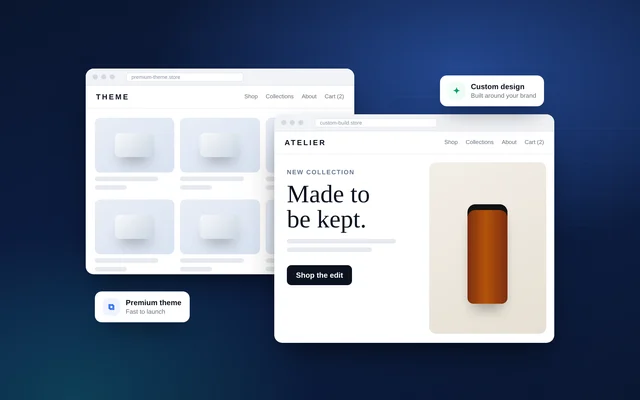
| Will you start from a theme or build custom, and why? | Recommendation tied to our products and budget | Custom for everyone, or a single theme for everyone |
| How do you handle theme updates? | Custom work kept in separate files; core files left untouched where possible | No answer, or edits throughout the theme |
| How do you choose apps? | Few, well-supported apps; preference for theme app extensions | A long app list in the proposal |
| How will you access our store? | Collaborator account with limited permissions, on a store we own | Asks for the owner login, or opens the store in their name |
| What does your QA include? | Device and browser testing, test orders per payment method, tracking checks | "We test everything" with no checklist |
| Who owns the code and designs? | Assigned to us in writing on payment | Silence on IP, or agency retains ownership |
| How do you use version control? | Theme in Git, changes reviewed before going live | Edits made directly on the live theme |
| What happens after launch? | Defined support period, documentation and optional retainer | Handover is "you get the login" |
| How will we communicate? | Named contact, overlap hours, regular written updates | Ad hoc messages and no fixed rhythm |
What Are the Red Flags When Hiring a Shopify Agency?
The biggest red flags concern ownership, transparency and process: opening the store under the agency's account, refusing to name who does the work, and promising results that no one can guarantee.
- Guaranteed revenue or conversion uplifts. No agency controls your product, pricing or ad spend.
- Owner-level access requests. Shopify's collaborator accounts exist so partners never need your owner login.
- No written scope. If it is not written down, it will be argued about later.
- Heavy upfront payment for large projects with no milestones. Payment should track delivered work.
- A pitch built on app stacking. Every app adds cost, scripts and failure points.
- Reluctance to share references. Good agencies have clients willing to talk.
How Do You Check a Shopify Agency's Portfolio?
Visit the live stores, test them on your phone, and ask the agency to walk you through what they built on one of them. A real walkthrough is hard to fake.
When you visit, add a product to the cart, try the filters, open the menu and check page speed on mobile. Look for the kind of complexity your project needs: if you need a subscription builder or configurator, ask to see one working. Then ask for a reference from a client whose project resembled yours and ask that client about deadlines, communication and post-launch support.
Be aware that stores change after handover. A store that looks dated today may have been redesigned by someone else, which is why the walkthrough and the reference call matter more than first impressions.
Does Shopify Partner Status Matter?
Partner status matters as a baseline and as one quality signal. Professional Shopify agencies should be in the Shopify Partner Program; directory tiers indicate experience but do not replace your own checks.
The Shopify Partner Directory lists vetted service providers and shows four tiers based on experience and track record: Select, Plus, Premier and Platinum. Listings include reviews, work samples and certifications. A tier is a reasonable tiebreaker; many capable smaller agencies are untiered, and a tier does not tell you who will be assigned to your project.
The more practical point is access. Partners request access to your store as collaborators. Shopify's help centre explains that you can require a four-digit collaborator request code, set roles with only the permissions the partner needs, and that collaborators do not count towards your plan's staff limit. If an agency builds on a client transfer store in its own Partner organisation, Shopify confirms that after the transfer the merchant owns the store and it leaves the partner's organisation, so agree the transfer date in the contract.
What Should a Shopify Agency Contract Cover?
A Shopify agency contract should cover scope, milestones, acceptance criteria, payment, intellectual property, confidentiality, warranty and post-launch support. Intellectual property is the clause most often missing.
Do not assume that paying for work makes you its owner. In the UK, GOV.UK guidance states that the first owner of copyright in a commissioned work is the creator, not the commissioner, unless agreed otherwise in writing. In the US, the Copyright Office explains that work by an independent contractor is only a "work made for hire" if it falls into one of nine specific categories and both parties sign a written agreement saying so; most website code does not fit those categories cleanly. The safe route in both countries is an explicit written assignment of IP to your business on payment.
- Scope and exclusions: features, pages, integrations and what is not included.
- Milestones and acceptance: how each stage is reviewed and signed off.
- IP assignment: custom code, designs and content assigned to you; third-party themes and apps licensed under their own terms.
- Access and ownership: the store is owned by your business; credentials and repositories handed over at the end.
- Warranty period: how long defects are fixed at no extra cost.
- Confidentiality: mutual NDA terms, especially for unreleased products.
This article is general guidance, not legal advice; have a lawyer review contracts for larger projects. Our guide to outsourcing software development safely goes deeper on contracts across the US, UK and GCC.
How Do You Work with a Shopify Agency Across Time Zones?
Agree overlap hours, a single named contact and a fixed written update rhythm before work starts. Time-zone differences only hurt when communication is left to chance.
A few hours of daily overlap is enough for calls and quick decisions. Outside that window, work should be asynchronous and written: a shared task board, short daily or twice-weekly summaries, and screen recordings for design feedback. Used well, the gap becomes an advantage, because feedback sent at the end of a UK or US working day can be addressed by the next morning.
Agencies that work this way often also supply other agencies; if you run an agency yourself, see white-label Shopify development.
How Do You Compare Proposals Fairly?
Compare proposals on scope and assumptions first and price second. Two proposals with different numbers usually describe different projects.
Put each proposal's scope, exclusions, content responsibility, QA and support period side by side. Ask each agency to fill the gaps, then compare again. Our breakdown of Shopify store cost drivers and the comparison of custom vs premium Shopify themes will help you judge whether each proposal's approach fits your project.
How VEATEX Helps
VEATEX is a Shopify, web and software development agency that also builds Peppol e-invoicing platforms for the GCC, working with clients in the US, UK and the Gulf for over 11 years. We work through collaborator accounts on stores our clients own, itemise custom features in written scopes, and assign custom work to clients on payment. html">work page. To ask us the questions above, start with our Shopify development service.
Frequently Asked Questions
Should I hire a Shopify agency or a freelancer?
A freelancer can suit a small, well-defined job such as theme configuration or a single custom section. An agency suits projects that need design, development, QA and project management together, or where you need continuity if one person is unavailable. Whoever you hire, the same checks apply: relevant live work, clear scope, written IP terms and store access through collaborator accounts.
Does an agency need to be a Shopify Partner?
Anyone building stores for clients professionally should be in the Shopify Partner Program, because it gives access to collaborator accounts and development stores. Higher Partner Directory tiers such as Plus, Premier and Platinum reflect experience and track record with Shopify, but many capable smaller agencies are not tiered. Treat tier as one signal alongside portfolio, process and references.
Who should own my Shopify store and code?
Your business should be the store owner on the Shopify account, and the contract should assign all custom code, designs and content created for you to your business on payment. If an agency builds on a development or client transfer store, ownership should be transferred to you before launch. Third-party themes and apps remain licensed, not owned, under their own terms.
How do I check a Shopify agency's portfolio is genuine?
Ask for live store URLs, not just screenshots, and confirm the stores are on Shopify. Ask which parts the agency built: theme configuration, custom sections, apps or integrations. Request one or two client references you can speak to, and check whether the agency's listing in the Shopify Partner Directory shows matching reviews and work samples.
Can an agency in another time zone work well with a US or UK brand?
Yes, if communication is designed rather than assumed. Agree a few hours of daily overlap, a named project lead, written daily or twice-weekly updates, and a shared task board. Asynchronous work can be an advantage: feedback given at the end of your day can be done by the next morning. Problems arise when there is no overlap and no written process.
What should happen after my Shopify store launches?
Expect a defined post-launch support period for bug fixes, a handover of documentation and access, and the option of an ongoing retainer for changes and improvements. The agency should explain how they will handle future theme updates, app changes and Shopify platform changes, such as checkout and tracking upgrades. Agree response times for urgent issues in writing.
Sources
- Shopify Partner Directory — Shopify
- Collaborator accounts — Shopify Help Center
- Transferring client transfer stores — Shopify Help Center
- Ownership of copyright works — GOV.UK
- Circular 30: Works Made for Hire — U.S. Copyright Office
- Updating themes — Shopify Help Center
Facts checked against the sources above as of 6 Oct 2026. Rules and platform features change, so confirm time-sensitive details before acting.

VEATEX Editorial Team
Written by the strategists, developers and e-invoicing engineers at VEATEX, a Shopify, web and software development agency that also builds Peppol e-invoicing platforms for the GCC, with 1,200+ projects delivered over 11+ years. About us