Quick answer
A landing page for Meta or Google Ads should repeat the ad's exact promise in its headline, show one offer and one call to action above the fold, use a short or multi-step form, display proof close to the form, load quickly on mobile, and track conversions accurately with GA4, the Meta Pixel plus Conversions API, and a working consent setup.
Key takeaways
- Message match between ad and page is the first job: the headline should confirm the visitor is in the right place.
- Google search traffic arrives with intent; Meta traffic is interrupted mid-scroll, so Meta pages need more context and proof.
- Multi-step forms reduce the perceived effort of longer forms; ask easy questions first and contact details last.
- Landing page experience is one of three Quality Score components in Google Ads, alongside expected CTR and ad relevance.
- Run the Meta Pixel and Conversions API together with a shared event_id so Meta can deduplicate events.
Paid traffic is the most expensive traffic most businesses buy, and the landing page decides whether that spend turns into leads or sales. A strong ad pointed at a generic page leaks money on every click; a modest ad pointed at a page built for that exact click often wins.
This guide covers how to build landing pages for Meta (Facebook and Instagram) and Google Ads: message match, layout, forms, trust, speed, tracking and testing. Platform details are accurate as of October 2026; ad platforms update their tools often, so check the linked documentation before you configure anything.
What Makes a Landing Page Work for Paid Ads?
A landing page works when it confirms the ad's promise immediately, presents a single offer and asks for one action. Everything on the page should either build the case for that action or make it easier to take.
A landing page is a standalone page built for a specific campaign or audience, usually without the full site navigation. That focus is the point. Your homepage serves investors, job seekers, existing customers and prospects at once; a landing page serves one visitor arriving from one ad with one question: "Is this what I clicked for, and what do I do next?"
Why Does Message Match Matter, and How Is It Different on Meta and Google?
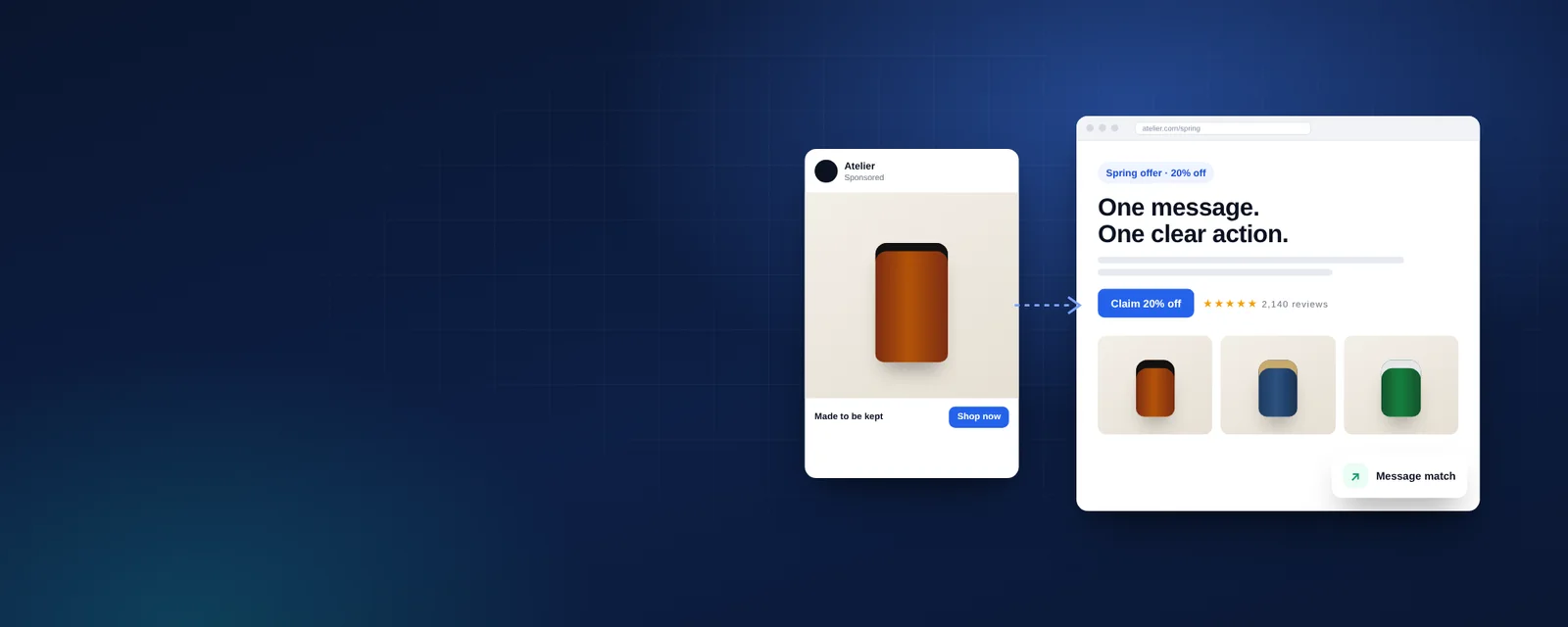
Message match means the landing page headline, offer and imagery echo the ad that brought the visitor. Without it, visitors wonder whether they are in the right place and leave. The approach differs by platform because the visitor's state of mind differs.
| Factor | Google Search ads | Meta ads |
|---|---|---|
| Visitor's mindset | Actively searching; has a problem and a query | Interrupted while scrolling; curiosity, not intent |
| What to match | The search term and ad headline, almost word for word | The creative's hook, visual style and offer |
| Above the fold | Confirm the answer, show the offer and the action quickly | Re-establish the hook, then explain why it matters |
| Page length | Often shorter; the decision is partly made | Often longer; more proof and explanation needed |
| Proof style | Credentials, ratings, guarantees, specifics | Testimonials, user-generated content, before and after, demonstrations |
For Google, structure ad groups tightly enough that each one can point to a page whose headline mirrors its keywords. For Meta, keep the landing page visually continuous with the creative: if the ad is a founder-to-camera video, a polished stock-photo hero breaks the thread. Our guide to UGC-style ads made with AI covers keeping that continuity credible.
What Should Go Above the Fold?
Above the fold, meaning the part visible without scrolling, should hold a headline that matches the ad, a one-line explanation of the benefit, a primary call to action and at least one trust signal. On mobile, that space is small, so every element must earn its place.
- Headline: the ad's promise, stated as an outcome.
- Subheadline: who it is for and how it works, in one sentence.
- Primary call to action: a button with a specific verb ("Get my quote", "Book a 20-minute call") rather than "Submit".
- Trust signal: a rating, recognisable client logos, a guarantee or a credential.
- Relevant visual: the product, the result or the person, not decoration.
Remove the main navigation, or reduce it to a logo and a phone number. Every extra link is a way to leave without converting.
How Should You Design the Form, and Do Multi-Step Forms Help?
Ask only for what the next step genuinely requires, and when you need more, split it into steps. A multi-step form asks one or two questions per screen, starting with easy multiple-choice questions and ending with contact details.
Multi-step forms work because starting is easy and each completed step creates momentum. They also let you qualify leads without one intimidating wall of fields. A typical sequence for a service business:
- What do you need? (tappable options)
- When do you need it? (tappable options)
- Rough size or scope? (tappable options)
- Name, email and phone, with a clear statement of what happens next.
Practical rules that matter on mobile: use the right input types so phones show the correct keyboard, support autofill, show progress, keep error messages next to the field, and never clear entered data on an error. Capture partial submissions only if your privacy notice and consent setup allow it.
Interactive tools are a powerful version of this idea. The assessment platform we built for Herb Consulting, with scoring and PDF reports, turns a long questionnaire into something people want to finish because they get a result at the end.
Which Trust Signals Matter Most on an Ad Landing Page?
The best trust signals are specific, verifiable and placed next to the moment of decision, usually beside or just below the form. Generic badges far from the call to action do little.
- Named testimonials with a photo, role and company, or reviews pulled from a third-party platform.
- Client logos you have permission to use.
- Concrete guarantees, such as response times or refund terms, stated plainly.
- Visible business details: company name, address and contact methods, plus privacy policy and terms links.
- For Gulf audiences, local contact options such as WhatsApp and a local phone number often matter as much as reviews.
Transparency also keeps ads running. Google's destination requirements disapprove ads whose landing pages do not work, are not crawlable by Google's ad crawlers, are unnecessarily difficult to navigate, or lack original content.
How Does Landing Page Experience Affect Google Ads Quality Score?
Landing page experience is one of the three components of Google Ads Quality Score, alongside expected clickthrough rate and ad relevance. Google describes it as how relevant and useful your landing page is to people who click your ad.
Quality Score is a diagnostic shown on a 1 to 10 scale at keyword level. Each component is rated "Above average", "Average" or "Below average" compared with other advertisers who showed ads for the same keyword over the last 90 days. Google's help centre notes that higher-rated landing pages are usually well organised, with text that relates to the person's search terms.
In practice, improving landing page experience means closer relevance to the keyword, clear and useful content, easy mobile navigation and fast loading. Google's web.dev guidance sets "good" Core Web Vitals as Largest Contentful Paint within 2.5 seconds, Interaction to Next Paint of 200 milliseconds or less, and Cumulative Layout Shift of 0.1 or less. Compress hero images, defer non-essential scripts and be strict about third-party widgets, which are often the heaviest thing on an ad landing page.
How Do You Set Up Tracking for Meta and Google Ads?
Track the same conversion consistently across GA4, Google Ads and Meta, send Meta events from both the browser and the server, and make all of it respect the visitor's consent choices. Broken tracking quietly teaches ad algorithms the wrong lessons.
Meta Pixel and Conversions API
The Conversions API (CAPI) sends events from your server to Meta. Meta's best-practice guidance recommends using it in addition to the Meta Pixel and sharing the same events through both. To avoid double counting, send the identical event_name and a matching event_id from browser and server; Meta deduplicates events received within 48 hours of the first event with that ID. Meta also notes that sending customer information parameters, such as hashed email and phone, may improve Event Match Quality.
GA4 and Google Ads
In GA4, mark your form submission or purchase as a key event, Google's term for an event that measures an action important to your business. Conversions in Google Ads can then be based on those key events so both platforms report consistently. For lead generation, enhanced conversions send hashed first-party data such as email addresses (using SHA-256) to improve measurement, and enhanced conversions for leads can match offline sales back to the ad click.
Consent
Google's consent mode v2 uses four parameters: ad_storage, analytics_storage, ad_user_data and ad_personalization. In basic mode, Google tags are blocked until the visitor interacts with the consent banner; in advanced mode, tags load with consent denied by default and send cookieless pings until consent is given. Advertisers with visitors from the European Economic Area are expected to send all four. In the UK, the Data (Use and Access) Act 2025 relaxed consent for some low-risk cookies, but advertising tracking still requires care; follow the ICO's current guidance and take legal advice on your setup.
How Should You A/B Test Landing Pages?
Test one meaningful change at a time, such as the headline, offer, form structure or proof placement, and run each test until both versions have enough conversions to compare. Button colour tests rarely move results; offer and message tests often do.
Google Optimize was discontinued on 30 September 2023, so tests now run in third-party tools, landing page builders, your CMS or the ad platforms themselves. Google Ads custom experiments split traffic between an original and an experimental campaign, using a cookie-based split (each user sees only one version) or a search-based split (which Google says may reach statistical significance faster). Meta's Ads Manager offers its own A/B testing for creative and audience variables.
For ecommerce brands, many of the same principles apply to product pages that receive ad traffic; our guide to Shopify conversion rate optimisation covers that side, and our article on B2B website design covers longer sales cycles where the landing page is only the first step.
How VEATEX Helps
VEATEX is a Shopify, web and software development agency that also builds Peppol e-invoicing platforms for the GCC, working with clients in the US, UK and the Gulf for over 11 years. We design and build landing pages for Meta and Google campaigns, including multi-step forms, Pixel and Conversions API setups, GA4 key events and consent configuration, on WordPress, Webflow, Shopify or custom code. Start on our website design and development page; for scoping questions, see what determines website development cost.
Frequently Asked Questions
Should I send ad traffic to my homepage or a dedicated landing page?
Send it to a dedicated landing page whenever the ad makes a specific offer. A homepage serves many audiences and gives visitors many exits, while a landing page repeats the ad's promise, removes distractions and asks for one action. Homepages can work for brand searches, where people are looking for the company itself rather than a particular product or offer.
Does landing page speed affect Google Ads performance?
Google evaluates landing page experience as one of the three Quality Score components, judging how relevant and useful the page is to people who click. Speed affects usefulness directly: slow pages lose visitors before they see the offer. Aim for Core Web Vitals in the good range, including Largest Contentful Paint within 2.5 seconds on mobile.
Do I still need the Meta Pixel if I use the Conversions API?
Meta recommends using the Conversions API in addition to the Meta Pixel and sharing the same events through both. The server connection captures events the browser misses, while the Pixel provides browser signals. Send the same event_name and a matching event_id from both so Meta deduplicates them; deduplication works within 48 hours of the first event.
How long should a landing page form be?
As long as your sales process genuinely needs and no longer. Every field adds effort, so remove anything you can collect later. For qualification questions such as budget, timeline or company size, a multi-step form lets visitors start with easy choices before typing contact details. Test field count against lead quality, not just submission volume.
Can I use one landing page for both Google and Meta ads?
You can, but it is often better to create variants. Google search visitors already expressed intent and want confirmation and a quick path to act. Meta visitors were interrupted while scrolling and usually need more context, proof and explanation before converting. A shared template with different headlines, ordering and proof sections is a practical compromise.
What replaced Google Optimize for landing page A/B testing?
Google Optimize was discontinued on 30 September 2023. Teams now use third-party testing tools, built-in testing in landing page builders, server-side or CMS-based split testing, or platform experiments such as Google Ads custom experiments and Meta's A/B testing in Ads Manager. Whatever the tool, test one meaningful change at a time and wait for enough conversions.
Sources
- About Quality Score for Search campaigns — Google Ads Help
- Landing page experience — Google Ads Help
- Destination requirements — Google Ads Policies Help
- Conversions API best practices — Meta for Developers
- Handling duplicate Pixel and Conversions API events — Meta for Developers
- Set up consent mode — Google Tag Platform
- About consent mode — Google Ads Help
- About enhanced conversions — Google Ads Help
- About key events — Google Analytics Help
- About custom experiments — Google Ads Help
- Google Optimize sunset — Optimize Help
- Web Vitals — web.dev
Facts checked against the sources above as of 6 Oct 2026. Rules and platform features change, so confirm time-sensitive details before acting.
VEATEX Editorial Team
Written by the strategists, developers and e-invoicing engineers at VEATEX, a Shopify, web and software development agency that also builds Peppol e-invoicing platforms for the GCC, with 1,200+ projects delivered over 11+ years. About us